
Rare Japanese stamps
Rare Japanese stamps worth money
The rarest Japanese stamps are the hand-engraved issues of 1871 to 1876, led by the 1871 Dragon stamps in mon values. The only known 500 mon Dragon with inverted center sold for $5,570,760 at David Feldman in 2023. A withdrawn 1945 stamp and a few famous postwar issues also sell well, but most stamps from Japan's 1970s and 1980s collecting boom trade below face value.
Free to download on iPhone. Premium is required for full features.
Which Japanese stamps are rare?
Japan's first stamps went on sale on 20 April 1871. The Dragon, Dragon sen, Cherry Blossom and Bird issues that followed until 1876 were all engraved by hand, plate position by plate position. Japanese collectors call them tebori kitte, hand-engraved stamps, and they are the heart of Japanese classic philately.
Few of these early stamps survive, and their catalogue values are high. Forgeries are everywhere, though: the International Society for Japanese Philately says many collectors find the problem almost unmanageable. A Dragon stamp in a shoebox is far more likely to be a forgery than the real thing.
8 notable rare Japanese stamps
Listed roughly in date order, not ranked by price. Figures are only given where a named source records them.
Dragon stamps, mon issue
1871
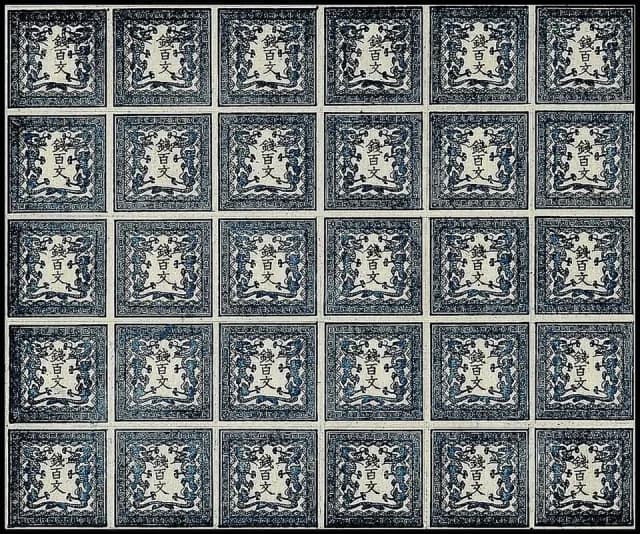
The 100 mon Dragon design of 1871. Design reference image, not authenticated. - Why it is rare
- Japan's first stamps came in four values: 48, 100, 200 and 500 mon. Each plate of 40 was engraved by hand by Matsuda Atsutomo, so every position differs slightly. Few survive, which is why catalogue values are high.
- What drives the value
- Value and plate, shade, plate position, and multiples and covers. Genuineness comes first, because forgeries vastly outnumber real copies in circulation.
- How to recognize it
- Two dragons framing a central value in Japanese characters, on thin Japanese paper, imperforate and without gum. Colors: 48 mon brown, 100 mon blue, 200 mon vermilion, 500 mon blue-green. Mon values appear only on this issue.
Dragon 500 mon with inverted center
1871
- Why it is rare
- At least 40 copies of the error must have been printed, but only one is known. It was found in the United States in 1973, used. Japanese catalogues value it at ¥35 million, the highest catalogue value of any Japanese stamp.
- What drives the value
- It is unique: the only known example of the major error on Japan's first issue.
- How to recognize it
- The blue-green 500 mon Dragon with the central value printed upside down. Any other copy offered would need extraordinary proof.
- Documented figures
- Sold by David Feldman SA in Geneva on 3 June 2023 for $5,570,760, according to Wikipedia's list of the most expensive philatelic items.
Dragon stamps, sen issue
1872
- Why it is rare
- After the currency reform the Dragon design was reissued with values in sen and rin (100 mon became 1 sen, 48 mon became 5 rin). It was Japan's first perforated stamp and was short-lived, replaced by the Cherry Blossom issue in 1872.
- What drives the value
- Value, plate, paper, the condition of the perforations and centering.
- How to recognize it
- The same dragon design as 1871 but with sen or rin values and perforations. The mon issue has no perforations at all.
Source: Wikipedia (Japanese)
Cherry Blossom issues
1872–1876
- Why it is rare
- Hand-engraved plates, many printings and kana control marks added partway through produced a large number of varieties, some of them scarce. Japanese Wikipedia calls it the most popular series among Japanese collectors, so demand is strong.
- What drives the value
- The kana mark, plate, paper type and condition. Specialists pay for scarce kana and paper combinations.
- How to recognize it
- Cherry blossoms in the four corners, values in sen, perforated. Look for a small kana syllable in the design; it identifies the printing.
Sources: Wikipedia (Japanese), Wikipedia (Japanese)
1913 forged Chrysanthemum stamps
1913
- Why it is rare
- In 1913 forgers produced fake Chrysanthemum stamps that were so crude post-office clerks spotted them. Very few circulated, and the forged stamps are now rarer and more valuable than the genuine ones.
- What drives the value
- Proof that the item is one of the 1913 postal forgeries rather than a later philatelic fake.
- How to recognize it
- The Chrysanthemum definitives of 1899–1908 carry the imperial chrysanthemum crest prominently in the design. Genuine stamps are common; the 1913 forgeries are crude by comparison. Only an expert can confirm one.
Source: Wikipedia (Japanese)
'Enemy Nations Surrender' 10 sen
1945
- Why it is rare
- The design shows the Hakozaki Shrine plaque reading 'enemy nations surrender'. A grey version went on sale in April 1945 and a blue version was printed from August. On 24 August 1945 the stamp was withdrawn for fear of provoking the occupation forces. 117,378,400 copies had been destroyed in air raids, most recovered stock was melted down, and 400 sheets (40,000 stamps) were sold through a philatelic association in June 1946.
- What drives the value
- The blue printing, which barely reached the public, is the one collectors chase. Covers and condition matter too.
- How to recognize it
- A 10 sen stamp with the four characters 敵国降伏 on a shrine plaque, in grey or blue.
Source: Wikipedia (Japanese)
'Beauty Looking Back' (Mikaeri Bijin), Philatelic Week
1948
- Why it is rare
- Famous rather than rare. Japan Post says the stamp caused a sensation when it was issued and is said to have influenced stamps abroad. It was perforated with a gauge meant for high-value revenue stamps, and together with the 1949 Moon and Geese it is among the largest Japanese stamps.
- What drives the value
- Demand from Japanese collectors, condition, and whether it is a single or a complete sheet.
- How to recognize it
- A large vertical stamp reproducing Hishikawa Moronobu's painting of a woman in a kimono looking back over her shoulder.
Sources: Japan Post, Wikipedia (Japanese)
'Moon and Geese' (Tsuki ni Kari), Philatelic Week
1949
- Why it is rare
- Issued on 1 November 1949 with a face value of 8 yen and a reported print run of 2 million. Like Beauty Looking Back, it is valued for its fame rather than scarcity.
- What drives the value
- Condition, full sheets and demand from Japanese collectors.
- How to recognize it
- A large vertical stamp after Utagawa Hiroshige's print of geese flying across the moon.
Sources: Financial Field, Wikipedia (Japanese)
What are most Japanese stamps worth?
Most Japanese stamps are common. During the collecting boom of the 1970s and 1980s each commemorative was printed in runs of 30 to 50 million, and discount ticket shops in Japan trade them below face value.
Definitives of the 20th century were printed for everyday mail and are usually worth little used. The hand-engraved stamps of 1871 to 1876 are the exception, and even there the first question is whether a stamp is genuine.
How to identify Japanese stamps
These checks narrow a stamp down to the exact issue. That matters because a rare variety and a common one often share the same design.
Mon means 1871
The 1871 Dragons were valued in mon, a currency already superseded by the yen. Sen (1/100 yen) and rin (1/10 sen) appear from 1872.
Imperforate on thin paper
Imperforate stamps on thin native paper without gum point to the 1871 Dragons; the first perforated stamps were the 1872 sen Dragons. Do not confuse them with the 1923 earthquake emergency stamps, which were also sold imperforate and without gum.
The chrysanthemum crest
The imperial chrysanthemum crest appeared on Japanese stamps until 1947 in place of the emperor's portrait, and was dropped from issues of August 1947 onward.
Read the inscription
The 1876 Koban series was the first inscribed 大日本帝國郵便 (Imperial Japanese Post). 日本郵便 arrived in August 1946, and NIPPON in Latin letters was added in 1966 under Universal Postal Union rules.
Every hand-engraved position differs
On the 1871–1876 issues each plate position is slightly different. That helps experts, but it means comparing your stamp with a single picture online proves little.
For a broader walkthrough, see the Japanese stamp identification guide and the checklist on how to identify rare stamps.
Fakes, reprints and forged overprints
The early issues are among the most forged stamps anywhere. The ISJP notes that the Dragon stamps have been extensively forged by several producers, including Wada Kotarō, Kamigataya, Hirose and the Spiro Brothers. Some forgeries carry the marks sankō, mozō or mihon (reference, imitation, specimen), but many do not.
If you collect the classics seriously, the ISJP's reference on forgeries of the Dragon, Cherry Blossom and Koban stamps is the standard tool. For anything expensive, get an expert certificate.
Rare Japanese stamps FAQ
What is the most valuable Japanese stamp?
The 1871 Dragon 500 mon with inverted center. Only one copy is known, and David Feldman sold it in Geneva on 3 June 2023 for $5,570,760. Japanese catalogues value it at ¥35 million, the highest catalogue value of any Japanese stamp.
Are old Japanese stamps worth money?
Some are. Genuine hand-engraved stamps from 1871 to 1876 are scarce and valuable, but forgeries of them are common. Stamps from the 1950s onward were printed in large numbers, and many from the 1970s and 1980s sell below face value in Japan.
How do I know if my Japanese Dragon stamp is real?
Assume it may be a forgery until proven otherwise. Check for marks such as sankō or mihon that label reproductions, compare with the ISJP forgery references, and have any promising copy certified. A photo identification can tell you which design and value you have, but not whether it is genuine.
Why is the 'Beauty Looking Back' stamp famous?
The 1948 Philatelic Week stamp reproduces Hishikawa Moronobu's painting Mikaeri Bijin. Japan Post says it caused a sensation when issued, and together with the 1949 Moon and Geese it is among the largest Japanese stamps. It is popular rather than rare, so condition drives the price.
Sources & References
- 竜文切手 (Dragon stamps) - Wikipedia (Japanese)
- 手彫切手 (Hand-engraved stamps) - Wikipedia (Japanese)
- 日本の普通切手 (Japanese definitive stamps) - Wikipedia (Japanese)
- 日本切手 (Japanese stamps) - Wikipedia (Japanese)
- 切手趣味週間 (Philatelic Week) - Wikipedia (Japanese)
- 敵国降伏切手 ('Enemy Nations Surrender' stamp) - Wikipedia (Japanese)
- 震災切手 (Earthquake emergency stamps) - Wikipedia (Japanese)
- Postage stamps and postal history of Japan - Wikipedia
- List of most expensive philatelic items - Wikipedia
- 切手趣味週間 (Philatelic Week) - Japan Post
- 「月に雁」切手の価値 - Financial Field
- Forgeries - International Society for Japanese Philately
- Monograph 4: forgeries of the Dragon stamps - International Society for Japanese Philately
A useful estimate, not a professional appraisal
Stamp values are estimates for general reference. Actual value depends on condition, centering, cancellations, gum, authenticity, provenance and current collector demand. For rare or potentially valuable stamps, consult a qualified philatelic expert or appraiser.
Check your Japanese stamps
Find out which of your stamps deserve a closer look
StampSnap identifies a stamp from a photo, with the country, year, series and denomination, and shows an estimated value range and rarity. Your first 3 scans are free, and exporting your collection is always free.
Free to download on iPhone