
Rare Stamp Identification
Find Out If Your Stamp Is Rare
Most stamps are common, but genuine rarities do turn up in old albums, inherited collections, and boxes of covers. This guide explains what actually makes a stamp rare, which details to check, and how to get a fast first answer with a photo.
Free to download, rated 4.5 on the App Store. Works on iPhone in 16 languages. Premium subscription required for full features.
What Makes a Stamp Rare?
Age alone does not create rarity. A rare stamp combines scarcity at the source, low survival, and real collector demand.
Low Print Runs
Stamps issued in small quantities, or withdrawn shortly after release, had fewer copies to begin with. Scarcity at the source is the foundation of rarity.
Errors and Varieties
Inverted centers, missing colors, imperforate sheets, and double prints escaped quality control in tiny numbers. Major errors are among the most valuable stamps in the world.
Early Classic Issues
The first stamps of a country, issued in the 1840s to 1870s, were often printed in modest quantities and heavily used, so few clean examples survive.
Survival and Condition
Most stamps were used, torn, or thrown away. A stamp can be common as an issue but rare in mint condition or with a clean, well-centered cancellation.
Collector Demand
Rarity only translates into value when collectors want the stamp. Popular countries, famous designs, and well-documented rarities command the strongest prices.
Documented Provenance
A recorded history of ownership and expert certificates add confidence and value, especially for stamps where forgeries are known to exist.
Key insight: a stamp printed in the millions is almost never rare, no matter how old it looks. If you want the full picture of how these factors interact, read our guide on what makes stamps valuable.
Famous Rare Stamps and Why They Matter
These celebrated rarities show the patterns behind rarity: first issues, dramatic errors, and stamps of which almost nothing survives.
Penny Black (1840)
Great BritainThe world's first adhesive postage stamp. Millions were printed, so used examples are collectible rather than rare, but fine mint copies and scarce plate varieties are highly sought after. Forgeries exist, so careful identification pays off.
Inverted Jenny (1918)
United StatesA 24-cent airmail stamp printed with the Curtiss JN-4 airplane upside down. Only one sheet of 100 errors reached the public, making it America's most famous stamp error.
Treskilling Yellow (1855)
SwedenA three-skilling stamp printed in yellow instead of the normal blue-green. Only a single example is known to exist, and it has repeatedly set records when sold.
British Guiana 1c Magenta (1856)
British GuianaA provisional one-cent stamp printed locally when a shipment from London ran short. The sole surviving example is widely described as the world's most valuable stamp.
Own something that resembles a Penny Black? Forgeries and reprints are common, so read our guide on how to identify a Penny Black from a forgery before celebrating. You can also browse detailed profiles of well-known rarities on our valuable stamps pages.
Signs Your Stamp Might Be Rare
Two stamps that look identical at first glance can differ enormously in rarity. These are the details worth checking on any promising stamp.
Perforation Varieties
Count the perforations along the edges. The same design was sometimes issued with different perforation gauges, and one version can be far scarcer than the other. Imperforate examples of normally perforated stamps can be significant errors.
Watermarks
Hold the stamp over a dark surface or use watermark fluid. Different watermark types on the same design often separate a common stamp from a rare one, particularly on British and Commonwealth issues.
Color Shades
Printings in different ink batches produced distinct shades. Some shades are catalogued separately and are much scarcer. Compare your stamp against reference images before assuming it is the common shade.
Printing Errors
Look for inverted design elements, missing colors, doubled impressions, and dramatic misalignments. Genuine errors are rare by definition, which is why they attract forgers and deserve expert confirmation.
Overprints and Surcharges
Text or new values printed on top of an existing stamp often mark provisional or occupation issues with very short lifespans. Genuine scarce overprints are also heavily forged, so authentication matters.
Paper and Gum
Paper type, thickness, and original gum distinguish printings that look identical from the front. Mint stamps with undisturbed original gum are consistently worth more than regummed or hinged examples.
Printing varieties are the deepest topic in rare stamp identification. Our rare printing varieties guide walks through inverted centers, missing colors, paper folds, and plate flaws in detail, with the terminology collectors and dealers actually use.
Why Condition and Authentication Matter
Rarity and condition work together. A scarce classic with a tear, a thinned spot, or a heavy smudged cancellation is worth a fraction of a sound example, while the same stamp with fresh color, full perforations, and light cancellation can be a genuine prize. Never attempt to clean, press, or soak a stamp you suspect is rare, and handle it with stamp tongs rather than fingers.
Authentication is just as important. The most valuable stamps are also the most forged, and overprints, cancellations, and even perforations have all been faked. For any stamp with a potentially significant value, a certificate from a recognized philatelic expertizing service is the standard the market expects. Reputable dealers and auction houses will usually require one before handling a major rarity.
The practical approach: identify first, estimate second, authenticate third. Get a precise identification of your stamp, form a realistic idea of its value range, and only invest in professional expertizing when the numbers justify it.
A Fast First Check: Photo, Identification, Rarity Level
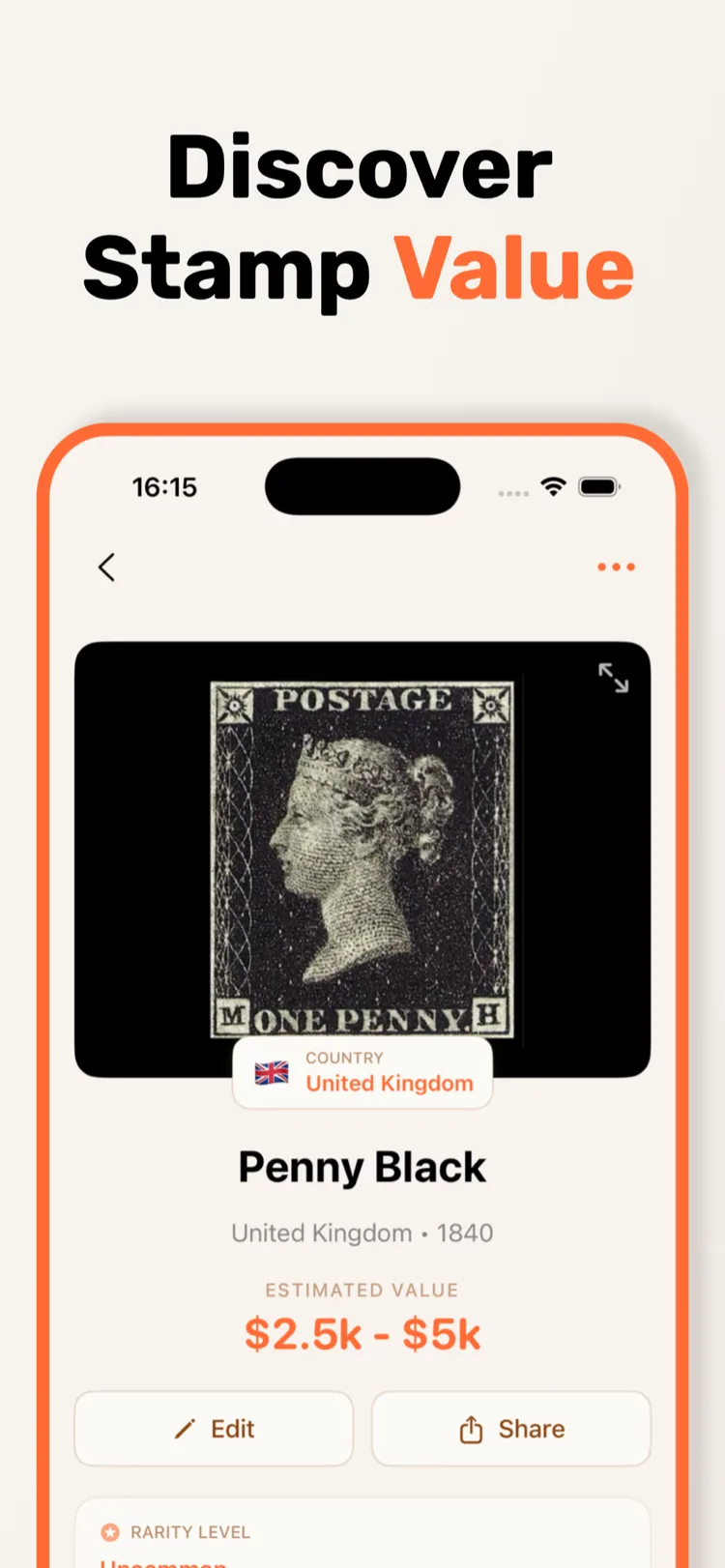
Working through catalogs takes hours when you do not know where to start. StampSnap gives you a first answer in seconds: take a photo of your stamp and the app identifies it, showing the country of origin, year of issue, design details, a rarity level, and an estimated value range.
Scan with the camera or upload a photo from your library, even for stamps still in albums.
See a rarity level and estimated value range for each identified stamp.
Every scan is saved to your history, so you can organize promising finds into albums and track your collection's value.
For anything that looks significant, treat the result as a starting point and have the stamp confirmed by a professional expertizing service.
How to Check a Stamp for Rarity, Step by Step
A simple routine that works for a single stamp or an entire inherited collection.
Identify the Stamp
Photograph the stamp in good light and let StampSnap identify the country, year, and design. Precise identification comes before any rarity judgment.
Check the Details
Review the rarity level and estimated value range, then inspect perforations, watermark, shade, and condition against the signs listed above.
Confirm High-Value Finds
If the estimate is significant, stop and get a professional appraisal or expert certificate before selling. Certification protects both value and buyer confidence.
Sorting through an old album or an inherited box? Our guide to identifying old stamps covers the full workflow, and the stamp value scanner page explains how value estimates work in more depth.
Rare Stamp Identification FAQ
How can I tell if my stamp is rare?
Start by identifying the stamp precisely: country, year of issue, denomination, and design. Then look for the details that separate rare varieties from common printings, such as perforation differences, watermarks, color shades, printing errors, and overprints. A photo identification app like StampSnap gives you a fast first answer with a rarity level and an estimated value range, and a professional expertizing service can confirm high-value finds.
Are old stamps automatically rare?
No. Many 19th century stamps were printed in the millions and survive in large numbers, so age alone does not make a stamp rare. Rarity comes from low print runs, low survival rates, printing errors, and strong collector demand. Some modern errors are far rarer than typical Victorian-era stamps.
Does condition matter for rare stamps?
Yes, condition has a major impact on value. Tears, thins, heavy cancellations, missing perforations, and stains all reduce what collectors will pay. A rare stamp in poor condition can still be valuable, but the same stamp in fine or mint condition is usually worth far more.
Can an app really identify rare stamps?
An app is an excellent first check. StampSnap identifies a stamp from a photo and shows the country, year of issue, design details, a rarity level, and an estimated value range. For potentially high-value stamps, especially suspected errors or classic rarities, we recommend confirmation by a professional philatelic expertizing service before buying or selling.
What should I do if I think I found a rare stamp?
Handle it carefully, ideally with stamp tongs, and do not try to clean it or remove it from paper. Scan it with StampSnap to get an identification and estimated value range, then compare it against catalog listings. If the estimate is significant, have the stamp authenticated by a recognized expertizing service before selling it.