
Rare German stamps
Rare stamps from Germany and what they are worth
The rarest German stamps are classics of the German states: the Baden 9 kreuzer color error, of which four are known, the Saxony 3 pfennig red and exceptional Bavaria Schwarzer Einser pieces. Later rarities include the 1901 Vineta provisional and the unissued 2001 Audrey Hepburn stamp. Most Reich, Bundespost, Berlin and DDR stamps are common, and many sell for a fraction of their catalogue value.
Free to download on iPhone. Premium is required for full features.
Which German stamps are rare?
German philately starts in 1849 with Bavaria's Schwarzer Einser, and for the next two decades each German state issued its own stamps. Those Altdeutschland issues hold most of Germany's real rarities. After 1871 come the Deutsches Reich, the occupation and postwar issues, West Germany, West Berlin and the DDR, each with a few scarce stamps among millions of common ones.
Two things trip people up. First, famous does not mean rare: a single used Schwarzer Einser sells for hundreds of euros, not millions. Second, German catalogue values often run far above what stamps actually sell for. Auction results are the better guide to a Germany stamp value.
10 notable rare German stamps
Listed roughly in date order, not ranked by price. Figures are only given where a named source records them.
Bavaria Schwarzer Einser, 1 kreuzer black
1849 · Michel 1
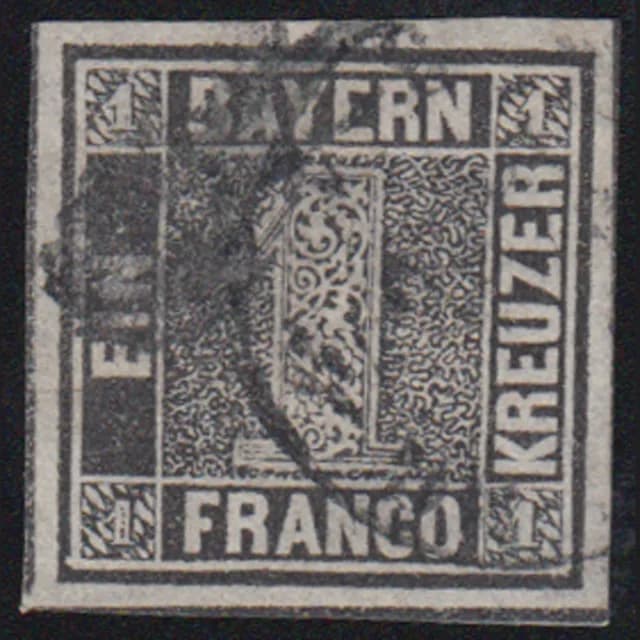
Bavaria's 1 kreuzer black of 1849, Germany's first stamp. Design reference image. - Why it is rare
- Germany's first stamp, issued on 1 November 1849. 832,500 were printed from two plates, so single used copies are valuable but not especially rare. The rarities are covers, strips, blocks and the tête-bêche.
- What drives the value
- Plate 1 or plate 2, four clear margins, the cancellation, and multiples or covers.
- How to recognize it
- A large numeral 1 in black, imperforate, with BAYERN at the top, FRANCO at the bottom and EIN KREUZER at the sides. The initials of its makers are hidden in the pattern of the numeral.
- Documented figures
- At Heinrich Köhler in September 2024 the only known first-day cover sold for €440,000, while single used copies in the same sale went for €580 to €1,300. A plate 1 block of 15 with a tête-bêche was hammered at €500,000 in the 2019 Erivan sale (CoinsWeekly).
Saxony 3 pfennig red (Sachsen Dreier)
1850 · Michel 1
- Why it is rare
- Issued on 29 June 1850 for newspaper wrappers, which were nearly all thrown away. 500,000 were printed, and 36,882 unsold stamps were burned in December 1851. The First Issues Collectors Club estimates that 3,000 to 4,000 survive.
- What drives the value
- Margins, shade (red, or the brownish red Michel 1c), plate position and multiples. Many copies have been repaired.
- How to recognize it
- A red numeral 3 in an ornamental frame, imperforate. The ink ranges from pale brick red to carmine.
- Documented figures
- At Heinrich Köhler in March 2024, single copies sold for €3,000 to €8,000 and a vertical pair from plate III for €17,000.
Baden 9 kreuzer color error
1851
- Why it is rare
- The 9 kreuzer was printed on the blue-green paper meant for the 6 kreuzer instead of on rose. Only three cancelled copies and one unused copy are known.
- What drives the value
- There are four. Provenance through the great collections, and the one example on a folded letter, set the price.
- How to recognize it
- A black numeral 9 on green paper. The normal 9 kreuzer is on pink paper and is far more common.
- Documented figures
- The unused copy sold at David Feldman for €1,314,500 on 3 April 2008 (Wikipedia). In the 2019 Erivan sale, the example on a folded letter was hammered at €1,260,000 (CoinsWeekly).
Oldenburg 1/3 groschen black on green, block of 12
1859
- Why it is rare
- Large multiples of the German states' classic issues are rare, and this block of 12 with wide margins on all sides is a famous example.
- What drives the value
- The multiple, its condition and its provenance. Single stamps of the same issue are worth far less.
- How to recognize it
- The Oldenburg arms printed in black on green paper, value 1/3 groschen, imperforate.
- Documented figures
- The block of 12 was hammered at €320,000 in the 2019 Erivan sale (CoinsWeekly; t-online names it as Oldenburg).
Sources: CoinsWeekly, t-online
Vineta provisional, 3PF on half of a 5 pfennig
1901 · Scott 65B
- Why it is rare
- Improvised aboard the cruiser SMS Vineta on 13 April 1901: 5 pfennig Germania stamps were cut in half and handstamped 3PF. Only 600 were issued.
- What drives the value
- A genuine Marine-Schiffspost No 1 postmark, being on piece or cover, and an expert certificate. Michel once listed it as no. 67, then withdrew the number after criticism.
- How to recognize it
- A vertically halved 5 pfennig Germania with a 3PF handstamp, tied by the Marine-Schiffspost No 1 postmark.
- Documented figures
- Spink has offered a mint copy at an estimate of $5,000–6,000 and a copy on piece at $2,500–3,000. These are estimates, not results.
Sources: Wikipedia, Spink, Spink Shreves
1930 Zeppelin South America flight set
1930 · Michel 438–439; Scott C38–C39
- Why it is rare
- Not rare in itself, but the watermark variety (Michel 438X–439X) is scarce, and flown covers are popular. Counterfeit overprints are known.
- What drives the value
- Watermark variety, never-hinged gum, plate flaws and genuine flown covers.
- How to recognize it
- Zeppelin airmail stamps overprinted SÜDAMERIKA FAHRT, values in Reichsmark. The 1933 Chicago flight set is overprinted Chicagofahrt Weltausstellung 1933.
- Documented figures
- At Rumsey Auctions in 2011 the 438X–439X watermark pair, catalogued at €4,000, realized $500, and the ordinary pair, catalogued at $480, realized $170. At Heinrich Köhler in 2024 a cancelled Chicago flight set sold for €270.
1948 Berlin black overprint set
1948 · Michel 1–20
- Why it is rare
- On 3 September 1948 twenty stamps of the second Control Council issue were overprinted BERLIN in black for West Berlin. The set itself is affordable. Overprint errors, period covers and certified pieces are where the value lies.
- What drives the value
- A genuine overprint, varieties and covers, plus a BPP certificate on better items. Forged cancels are a known problem on Berlin stamps.
- How to recognize it
- Allied occupation definitives with BERLIN overprinted in black. The 1949 red overprints (Michel 21–34) were sold only for Deutsche Mark.
- Documented figures
- At Heinrich Köhler in March 2024 a signed black overprint set sold for €150 and the same set on registered airlift covers for €450. The 1949 red overprint set sold for €240.
1951 Posthorn definitives
1951 · Michel 123–138
- Why it is rare
- Not rare, but the West German set collectors check first. Never-hinged complete sets sell in the hundreds of euros.
- What drives the value
- Never-hinged gum, centering and multiples. Hinged and used sets sell for much less.
- How to recognize it
- A posthorn design inscribed DEUTSCHE BUNDESPOST, in values from 2 to 90 pfennig.
- Documented figures
- Complete never-hinged sets sold for €420 to €520 at Heinrich Köhler in March 2024, and a 70 pfennig block of 15 brought €3,000.
DDR unissued 1984 Olympic stamps
1984
- Why it is rare
- The DDR boycotted the 1984 Los Angeles Olympics, and the stamps and souvenir sheet prepared for the Games were not issued.
- What drives the value
- Completeness (stamps plus souvenir sheet) and provenance.
- How to recognize it
- Olympic designs of 1984 in 5 to 25 pfennig values, plus a souvenir sheet, that do not appear among issued DDR stamps.
- Documented figures
- The unissued 5–25 pfennig values and souvenir sheet sold for €8,500 at Heinrich Köhler in March 2024.
Unissued Audrey Hepburn stamp
2001
- Why it is rare
- The German post printed 14 million Hepburn stamps in 2001, showing her as Holly Golightly in Breakfast at Tiffany's. Her son Sean Ferrer refused to grant the rights because the photo had been altered, with her sunglasses replaced by a cigarette holder, and the printed stamps were ordered destroyed. Only a handful escaped; in 2009 only five copies were known.
- What drives the value
- Each surviving copy is documented. Condition and provenance decide the price.
- How to recognize it
- A German stamp portraying Audrey Hepburn with a long cigarette holder. Any Hepburn design with the cigarette holder is the destroyed version.
- Documented figures
- Four single stamps that surfaced between 2004 and 2009 sold for €62,500 to €173,000, and a sheet of 10 fetched €430,000 at a charity auction in Berlin in October 2010 (AP via Christian Science Monitor).
Sources: Christian Science Monitor (AP), Post & Parcel
What are most German stamps worth?
Most German stamps are worth little, and many sell far below catalogue. In one 2024 Köhler lot, 1,500 never-hinged 1964 DDR souvenir sheets with a Michel value of €105,000 sold for €5,200, about €3.50 a sheet. A 1946 occupation stamp catalogued at €800 realized $80 at Rumsey Auctions in 2011.
Catalogue values are a reference, not a selling price. When you look up a Germany stamp value, compare recent auction results for the same Michel number and condition.
Even the DDR's deliberately short-printed values, the Sperrwerte, ran to large numbers: the first had 750,000 copies and later ones averaged about 2,100,000.
How to identify German stamps
These checks narrow a stamp down to the exact issue. That matters because a rare variety and a common one often share the same design.
Read the inscription
Reichspost on early Reich issues, then Deutsches Reich, and Grossdeutsches Reich late in the war. Deutsche Post before 1950, Deutsche Bundespost from 1950. West Berlin stamps read Deutsche Post Berlin and later Deutsche Bundespost Berlin.
Use the currency to place the era
Kreuzer in the south (Baden, Bavaria), groschen in the north (Oldenburg), pfennig in Saxony and across the Reich later. 1923 inflation stamps went up to 50 billion marks, and the 1930s Zeppelin stamps are in Reichsmark.
Watermarks and paper decide value
The same design can be worth many times more with a different watermark. The 1930 Zeppelin watermark pair is catalogued at €4,000 (about $5,480) against $480 for the ordinary pair. DDR definitives are split by watermark and by coated or ordinary paper.
Look for BPP marks
German experts of the Bund Philatelistischer Prüfer sign stamps on the back with their name and BPP, and forgeries get a 'falsch' mark. Above a certain catalogue value they issue a certificate instead of signing.
DDR short-printed values
From 1955 the DDR printed some values of a set in smaller quantities, the Sperrwerte. They are worth more than the rest of the set but are not rare.
For a broader walkthrough, see the German stamp identification guide and the checklist on how to identify rare stamps.
Fakes, reprints and forged overprints
The Schwarzer Einser is heavily forged, and Jean de Sperati made one of the best-known reproductions. The Sachsen Dreier has been repaired and forged extensively, notably by François Fournier.
Counterfeit overprints are known on the 1930, 1931 and 1933 Zeppelin stamps. On Berlin stamps the common trick is a forged rubber-stamp cancel, especially on souvenir sheet stamps, charity stamps and definitives.
For anything with real value, look for a current BPP certificate rather than an old signature.
Rare German stamps FAQ
What is the most valuable German stamp?
The Baden 9 kreuzer color error of 1851. Only four are known. The unused copy sold for €1,314,500 at David Feldman in 2008, and the example on a folded letter was hammered at €1,260,000 in the 2019 Erivan sale.
How much is a German stamp worth?
Most are worth cents to a few euros. Value depends on the exact Michel number, watermark, perforation, gum and cancellation. Use recent auction results for the same stamp and condition, because German catalogue values are often far above selling prices. StampSnap can give you the country, year, series and denomination from a photo, with an estimated value range, as a starting point.
Is the Schwarzer Einser valuable?
Yes, but less than people expect. 832,500 were printed. At Heinrich Köhler in September 2024, single used copies sold for €580 to €1,300, while the only known first-day cover reached €440,000.
Are DDR (East German) stamps worth anything?
Usually very little. DDR stamps were printed in large numbers, and even the short-printed Sperrwerte ran to hundreds of thousands of copies. Exceptions include unissued stamps, such as the 1984 Olympic set that sold for €8,500, and certain watermark and paper varieties.
Sources & References
- Schwarzer Einser - Wikipedia (German)
- One kreuzer black - Wikipedia
- Sale 384 results: Bavaria - Heinrich Köhler (via Stamp Auction Network)
- Historischer Brief aus Bayern für 440.000 Euro versteigert - Sonntagsblatt
- The most important sponsor of Berlin's Numismatic Collection collected stamps - CoinsWeekly
- Saxony first issue - First Issues Collectors Club
- Sachsen 3 Pfennige red - Wikipedia
- Sale 383 results: Saxony - Heinrich Köhler (via Stamp Auction Network)
- Baden 9 Kreuzer error - Wikipedia
- Deutsche Briefmarken: diese Marken machen Sammler reich - t-online
- Vineta provisional - Wikipedia
- The Sovereign Collection, lot 613: 1901 3PF Vineta provisional - Spink
- Lot 2480: Vineta provisional on piece - Spink Shreves
- Zeppelin mail - Wikipedia
- Sale 42: Germany - Rumsey Auctions
- Sale 42: Germany, Allied occupation - Rumsey Auctions
- Sale 383 results: Deutsches Reich - Heinrich Köhler (via Stamp Auction Network)
- Postgeschichte und Briefmarken Berlins - Wikipedia (German)
- Sale 383 results: Berlin - Heinrich Köhler (via Stamp Auction Network)
- Sale 383 results: Federal Republic - Heinrich Köhler (via Stamp Auction Network)
- Sale 383 results: DDR - Heinrich Köhler (via Stamp Auction Network)
- Sale 383 results: DDR souvenir sheet lots - Heinrich Köhler (via Stamp Auction Network)
- Audrey Hepburn stamps fetch $606,000 for charity - Christian Science Monitor (AP)
- Hepburn stamp sells for $93,800 - Post & Parcel
- Postage stamps and postal history of Germany - Wikipedia
- Sperrwert - Wikipedia (German)
- Prüfordnung - Bund Philatelistischer Prüfer
A useful estimate, not a professional appraisal
Stamp values are estimates for general reference. Actual value depends on condition, centering, cancellations, gum, authenticity, provenance and current collector demand. For rare or potentially valuable stamps, consult a qualified philatelic expert or appraiser.
Check your German stamps
Find out which of your stamps deserve a closer look
StampSnap identifies a stamp from a photo, with the country, year, series and denomination, and shows an estimated value range and rarity. Your first 3 scans are free, and exporting your collection is always free.
Free to download on iPhone